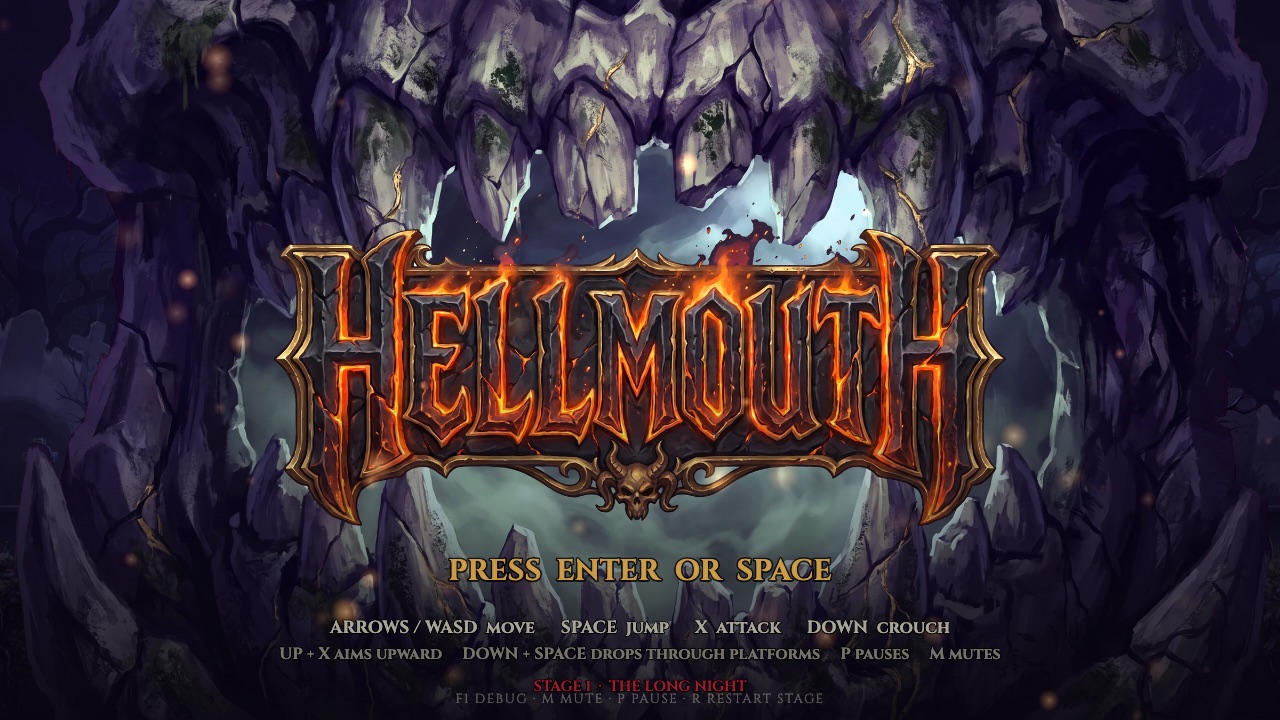
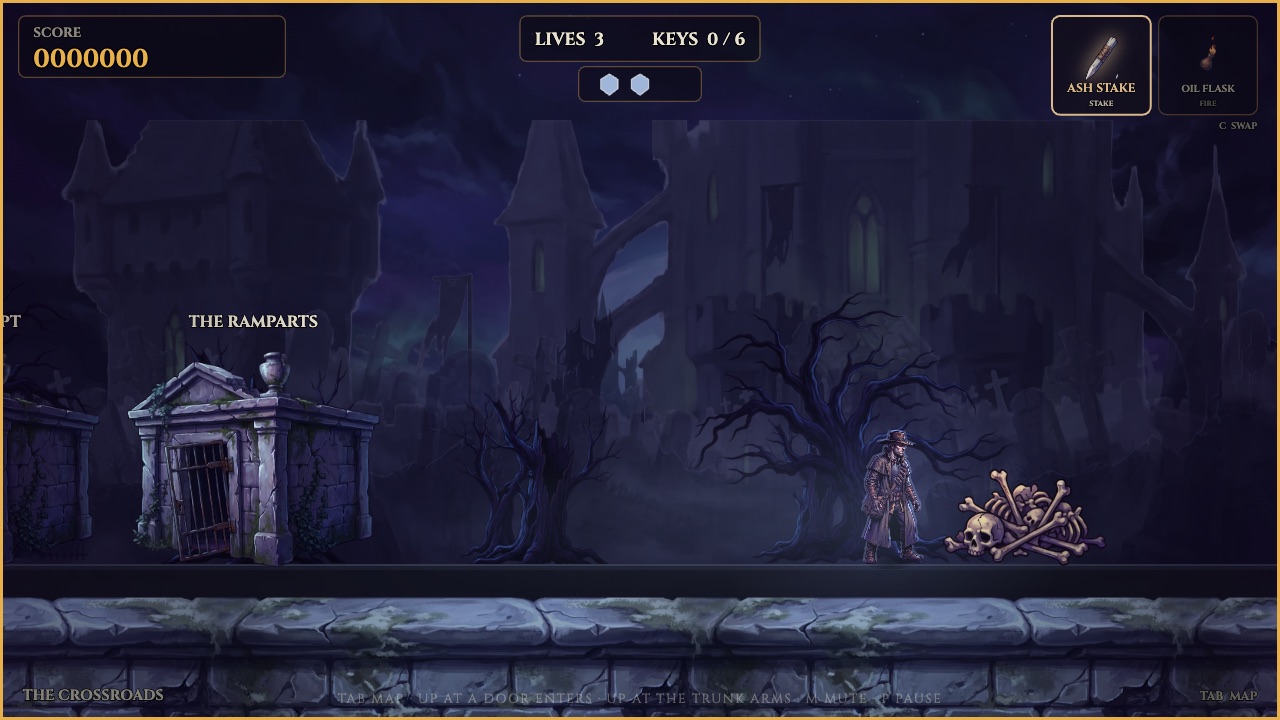
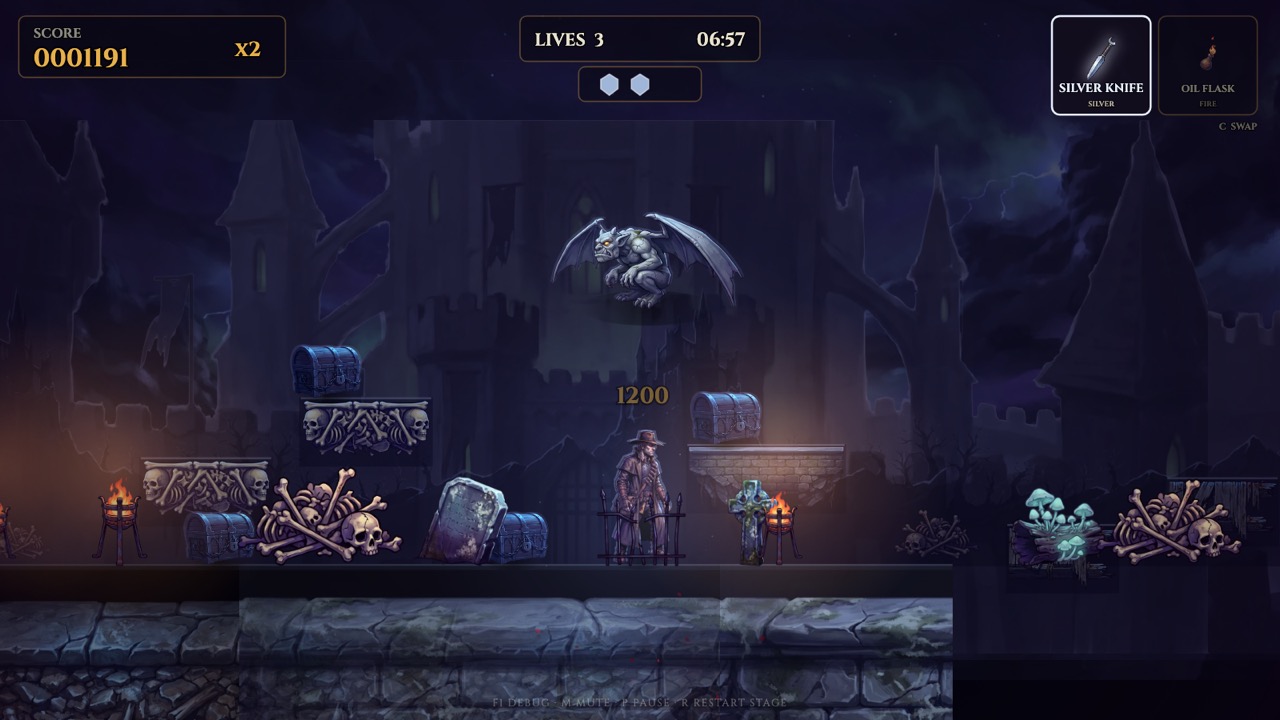
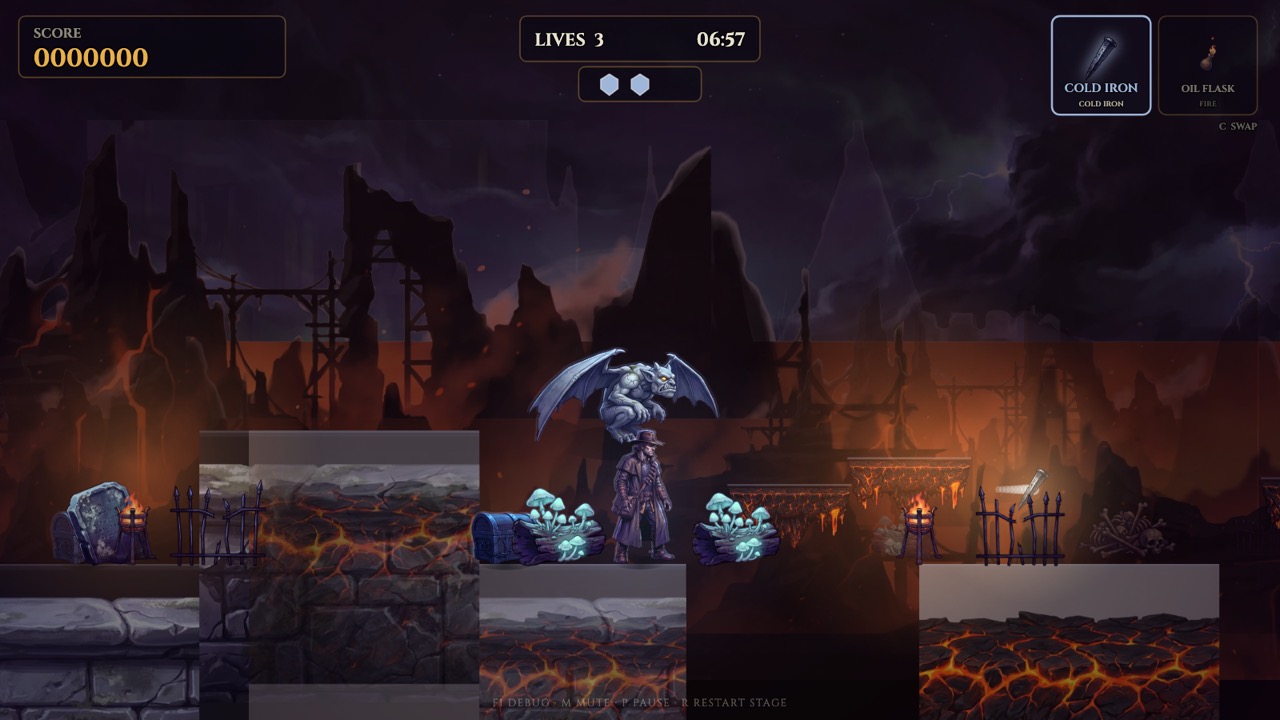
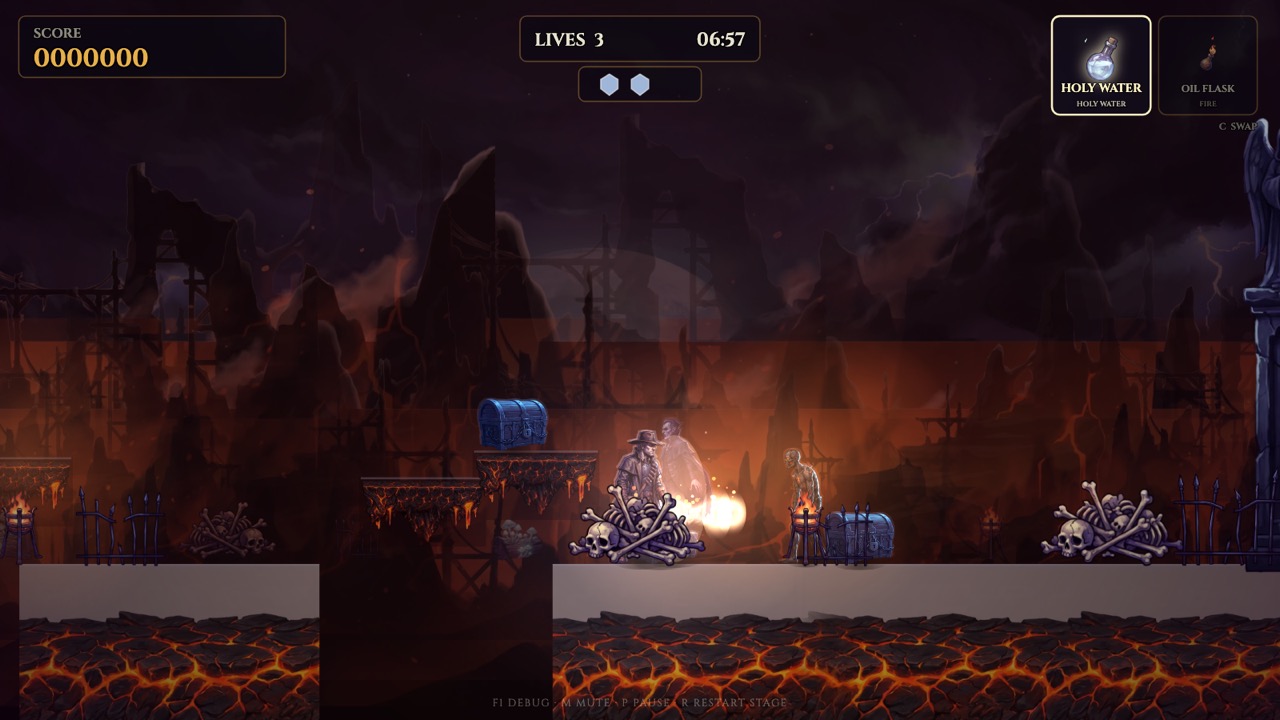
A gothic arcade side-scroller. A monster hunter in a long coat, two stages of things that answer
to different weapons, and a Hellmouth at the end of it. Built with Claude Code. Free to play in your browser.
Opens in a new tab. Keyboard on desktop, touch controls on phones and tablets. Sound on.
Thirty-three messages from the human. Everything else, from a blank folder to a playable stage, built by Claude Code while the human slept.
“I went to bed. Claude Code built an entire game overnight.” — Watch on YouTube
Every weapon carries a damage type. Every monster declares what each type does to it. That single table is the game.
You carry two weapons of six and swap between them. A chest overwrites the slot you are holding, so taking every chest in order is a real way to arrive somewhere holding two wrong answers. The loop stops being “find the best weapon” and becomes “read the monster, pick the answer, and don’t panic.”
| Kills | Wounds | Breaks | Staggers | Nothing |
|---|---|---|---|---|
| Dies on the spot. The matched weapon. | Ordinary damage against hit points. | Opens a two-stage monster up so it can be finished. | Knocked back, gets up. Buys time, nothing more. | No effect at all. Not reduced damage. None. |
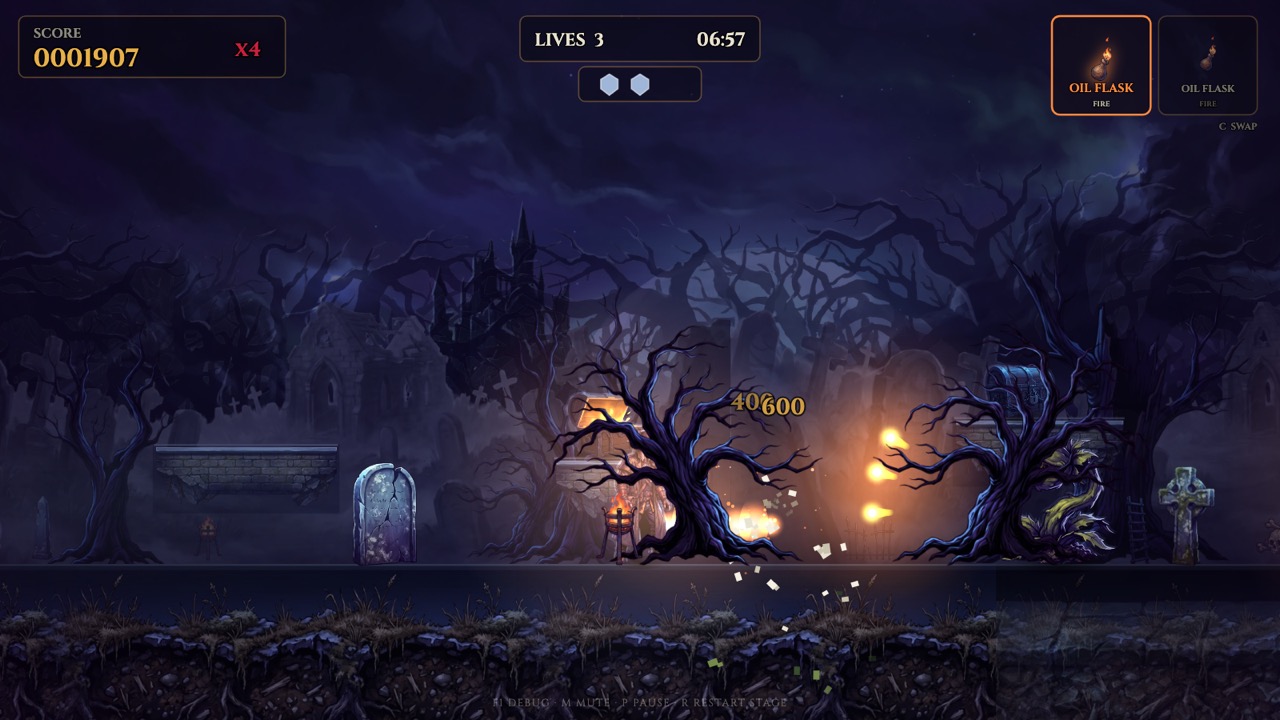
An oil flask ends a zombie. Steel only knocks it flat, and it gets back up. Fire does nothing to the charred.
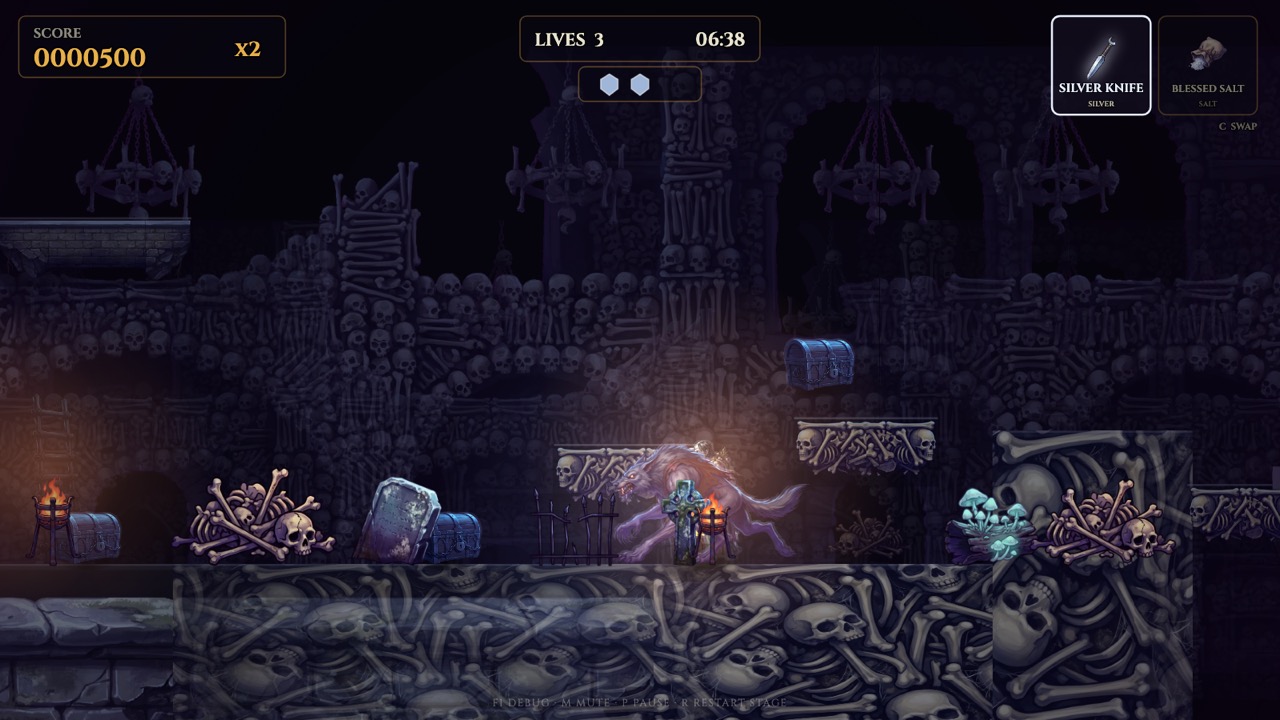
Only silver kills it. Anything else staggers it, the wound closes, and it comes back faster.
Phases through walls and ignores everything physical. Not reduced damage: none. It forces the swap.
Cannot be killed until holy water breaks it open. A two-step kill, introduced on a regular enemy so the boss fights read the same way.
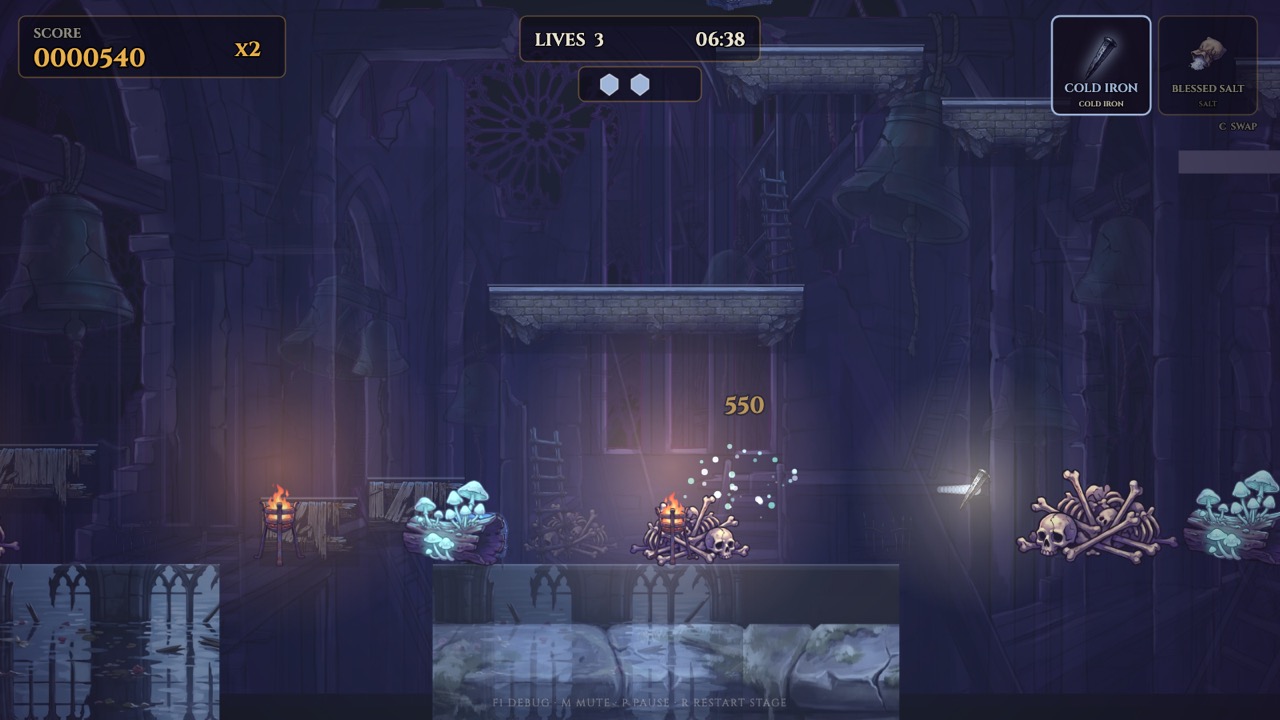
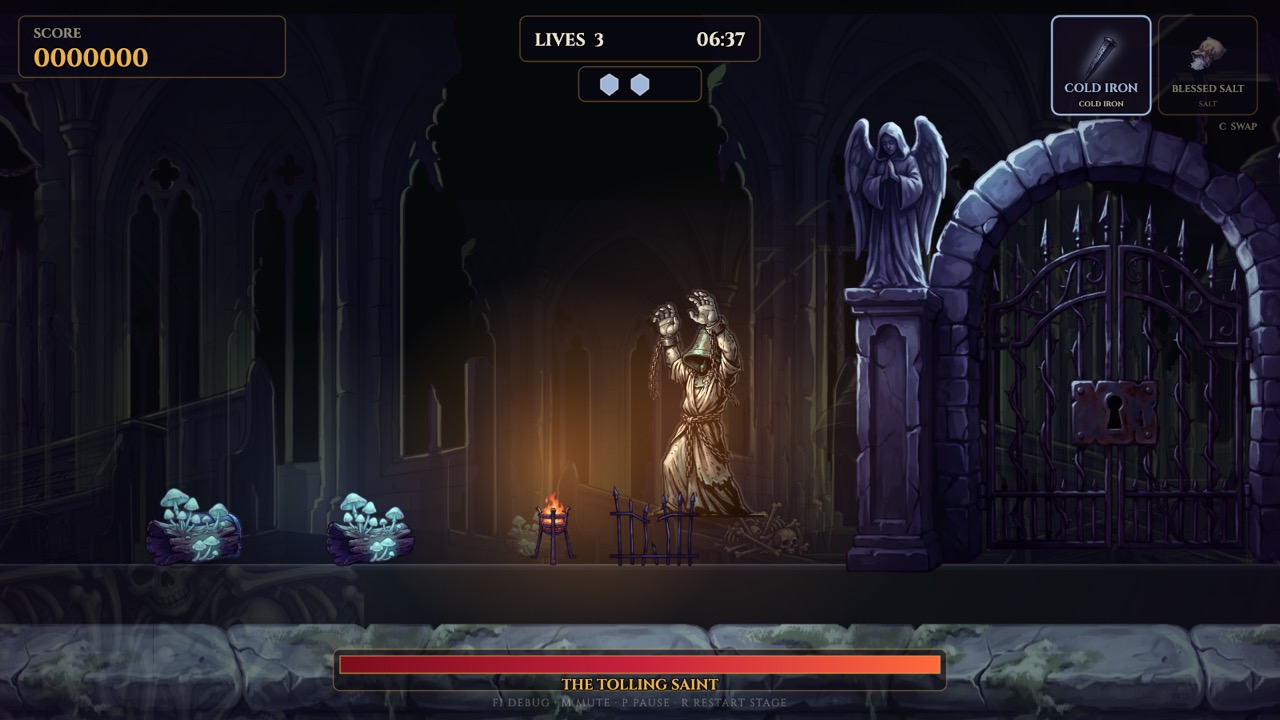
Owns the bell shafts of the second stage. Only cold iron touches it.
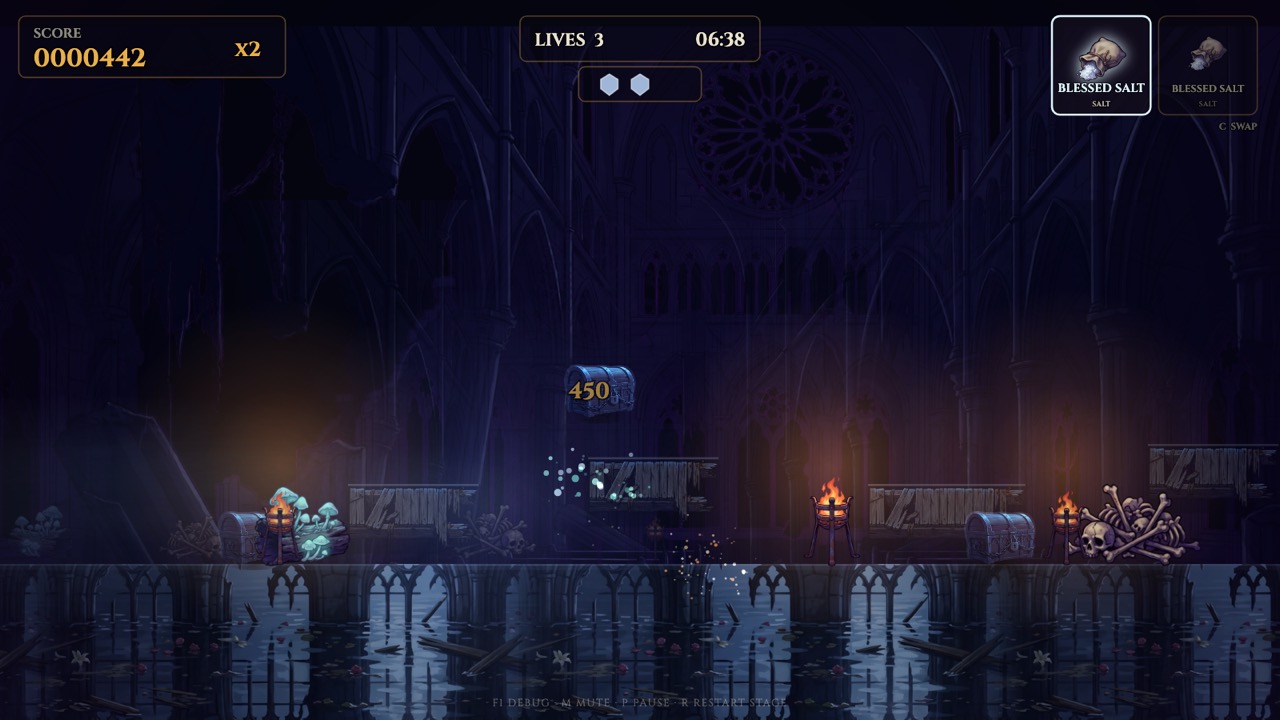
Anything puts a drowned down. Only salt keeps it down.
Each band of each stage teaches exactly one fact about the rule. Then the boss asks you to use all of them.
9,800 pixels across five biomes, from the graveyard down to the gates of Hell.
8,400 pixels, and it goes inside and upward: a sunken cathedral of ladders, swinging bells and black water.
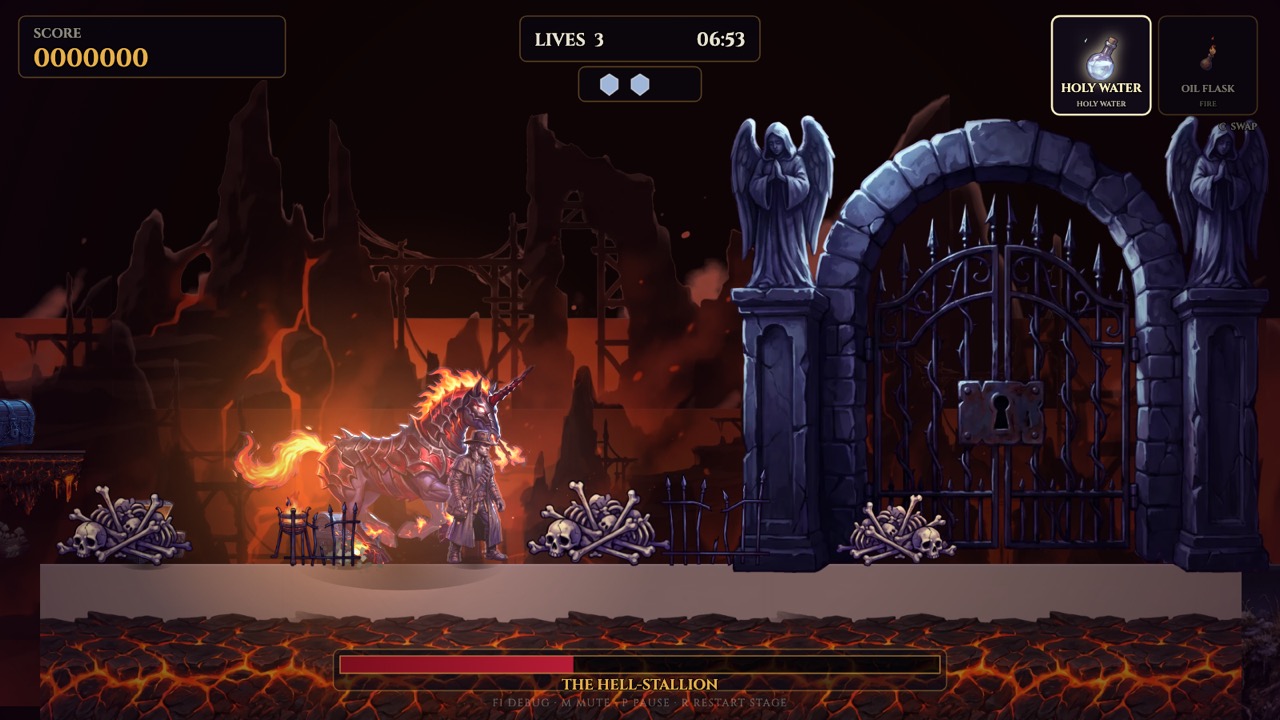
Stage 1 ends at the Hell-Stallion, a burning horse whose three phases each add a move rather than inflating numbers. Stage 2 ends in the Choir with the Tolling Saint, a chained, bell-wielding thing that owns the air rather than the ground.
Clearing stage 1 advances to stage 2 with your score and lives intact. There is a clock.
The same engine under a world instead of a corridor. The Crossroads is the hub: it holds the hunter’s trunk, everything ever found, pick two, and a door to each region. Every region ends in a key. Four are open from the start; two are found the long way.
A held region opens with an ordinary monster at its gate: a spectre, a werewolf, a bell-wraith, a vampire. Kill it and the gate stays open. The engine has no “requires silver” rule. It is just a werewolf.
The world is validated on load: a walk from the starting loadout must reach the last door holding every key, or the game refuses to start. Progress saves itself. This is the build behind the Play Game button.
Vanilla ES modules and a 2D canvas. No framework, no build step to play. Everything in it is original: characters, monsters, art, music and level design.
The engine and every sprite sheet are bundled into a single self-contained HTML file. It needs no server, no network and no relative paths, which is how it is hosted here.
The jump arc is the game’s identity, so it cannot be allowed to vary with frame rate. The jump is locked at takeoff: no air control, ever. Fixed virtual resolution, one transform to the device.
A monster is a stat block bound to one of seven reusable behaviours. A level is one file: terrain, spawner bands, chests, checkpoints, biomes and the boss. Levels are validated on load, including whether a weapon that can kill each monster can actually be in your hands by the time you meet it.
Asset sources are AI-generated filmstrips (Higgsfield), chroma-keyed and cut into sprite sheets by the build pipeline. The hunter, every monster, both bosses and the title are original designs made for this game.
Procedural sound effects, an adaptive music sequencer and a generated convolution reverb. Nothing sampled, nothing transcribed, nothing to download.
Nine test suites drive the real game in a real browser through a deterministic API. A deliberately mediocre bot plays each stage on three lives, and where it dies, bucketed by cause and by distance, is how the levels were tuned: a stage it can finish is a stage a person can finish.
Keyboard on desktop. On a phone or tablet the game draws its own touch controls.
In the open world: Tab opens the map, Up at a door enters it, Up at the trunk arms you, and C on the title screen continues a saved game.
From the graveyard to the choir.
Silver, and only silver, kills a werewolf.
The charred are immune to fire, over two lava crossings.
Break the vampire, then finish it.
Only salt keeps the drowned down.
Three answers, two hands.
It owns the air rather than the ground.
Free, in the browser, nothing to install. Sound on.